Your Meeting Transcripts Are a Graveyard
Open whichever AI notetaker you use and look at the list. Forty, eighty, two hundred meetings, each with a tidy summary and a bulleted set of action items. Now ask yourself honestly: when did you last reopen one that wasn’t from this week?
For most people the answer is never. The transcripts accumulate, the search works fine, and nobody searches. Meanwhile the thing you said you’d do in a call three weeks ago — send the revised scope, follow up with the vendor, check whether legal cleared it — either made it into your task list because you typed it there manually, or it quietly didn’t happen.
That’s the actual problem with meeting notes, and essentially the entire category is pointed somewhere else.
The category optimizes the wrong variable
Look at how these products compete. Word error rate. Speaker diarization. Language count. Real-time versus after-the-fact. Whether a bot appears in the participant list. Summary quality.
All of that is about producing a better record of the past. Almost none of it is about changing what happens next.
Which is strange, because nobody’s actual complaint is “my meeting notes were insufficiently accurate.” The complaint is “I forgot to do the thing,” or “we agreed on this and then both of us moved on,” or “I spent the first ten minutes of the follow-up call reconstructing what we decided.” Those are failures of follow-through, and a more accurate transcript does nothing for them. A perfect verbatim record of a meeting you never revisit is worth roughly the same as no record at all — arguably less, because it gave you permission to stop paying attention.
I’d go further: high-quality automatic notes can make follow-through worse. When you took notes by hand, the act of writing “I owe Sarah the pricing sheet by Thursday” put it in your head and usually onto a list. When a tool captures everything, the felt need to process it disappears. The capture is complete and the follow-through is zero. That’s a bad trade dressed up as a productivity win.
The handoff is the whole problem
Here’s the actual sequence for anyone who’s tried to make this work:
- The meeting ends.
- The notetaker produces a summary and a list of action items. Genuinely good ones, often.
- You read them. Maybe.
- You open your task manager and retype the three that are yours.
- Step 4 doesn’t happen.
Step 4 is the entire game, and it’s the step every product treats as somebody else’s job. It’s boring, it’s manual, and it happens at the exact moment you’re least likely to do it — you’ve just come out of one meeting and you’re walking into the next.
The industry’s answer is integrations. Push action items to Asana, Notion, Slack, a CRM. And integrations genuinely help. But they move text between systems; they don’t convert a spoken commitment into a thing you’ll be reminded about at the right time. A bullet that lands in a Notion database titled “Meeting Action Items” is in a different graveyard with better lighting.
What a commitment needs to survive
A line of text and a task are not the same object. For “I’ll get you the revised numbers” to become something that actually happens, it needs four things the transcript doesn’t have:
An owner. “We should look at the pricing” is not a task. “Sarah is checking the pricing” is. Most extracted action items are ownerless, which means they’re everyone’s and therefore nobody’s. This is genuinely hard to get right automatically — it requires knowing who was speaking and whether they volunteered or were assigned.
A due date, or at least a horizon. “Soon” decays into never. Even a wrong date beats none, because a wrong date surfaces the item for you to fix.
Context you can reconstruct from. Three weeks later, “follow up with the vendor” is useless without a link back to which conversation, what was decided, and what the vendor actually said. The task needs a path back to the transcript, not a copy of it.
A home you already look at. This is the one that kills the others. If the action item lives in your notetaker, and your actual work lives in your task manager, the action item does not exist. You will not check two systems. Nobody checks two systems.
That last point is why I don’t think this is fixable with a better notetaker. It’s a structural problem: a standalone meeting tool can only ever hand off, and every handoff is a place for things to fall through.
The honest counterargument
There are meetings where the record genuinely is the point, and I don’t want to overstate this.
Sales teams reviewing calls for coaching need the archive — that’s the product, and Fireflies and Fathom are built correctly for it. Anyone in a regulated context who needs to demonstrate what was said needs a durable record, not a task. Researchers doing customer interviews are mining transcripts for patterns, and follow-through isn’t the goal. A team wiki of every all-hands is legitimately useful to the person who joins in six months.
If that’s your use case, the transcript-first tools are right and this whole argument doesn’t apply to you.
But if you’re one person with fifteen meetings a week, most of them generating two or three things you personally owe somebody — the archive is not your problem. You have never once needed the verbatim record of a Tuesday check-in. You have absolutely forgotten what you promised in one.
What we built instead
This is the reason Life Manager Pro puts meeting capture inside a life-management app rather than shipping a standalone recorder, and it’s the one design decision I’d defend hardest.
The recording and local transcription work the way you’d expect — no bot in the call, Whisper on your own Mac. What’s different is what happens at step 4. Extracted action items become real tasks in the same system as your projects and goals, with owners attached where the conversation made it clear, optionally created the moment analysis finishes so there’s no step 4 at all. Meeting participants connect to CRM contacts, so the follow-up sits alongside everything else you know about that person. The task links back to the meeting, so three weeks later the context is one click away rather than gone.
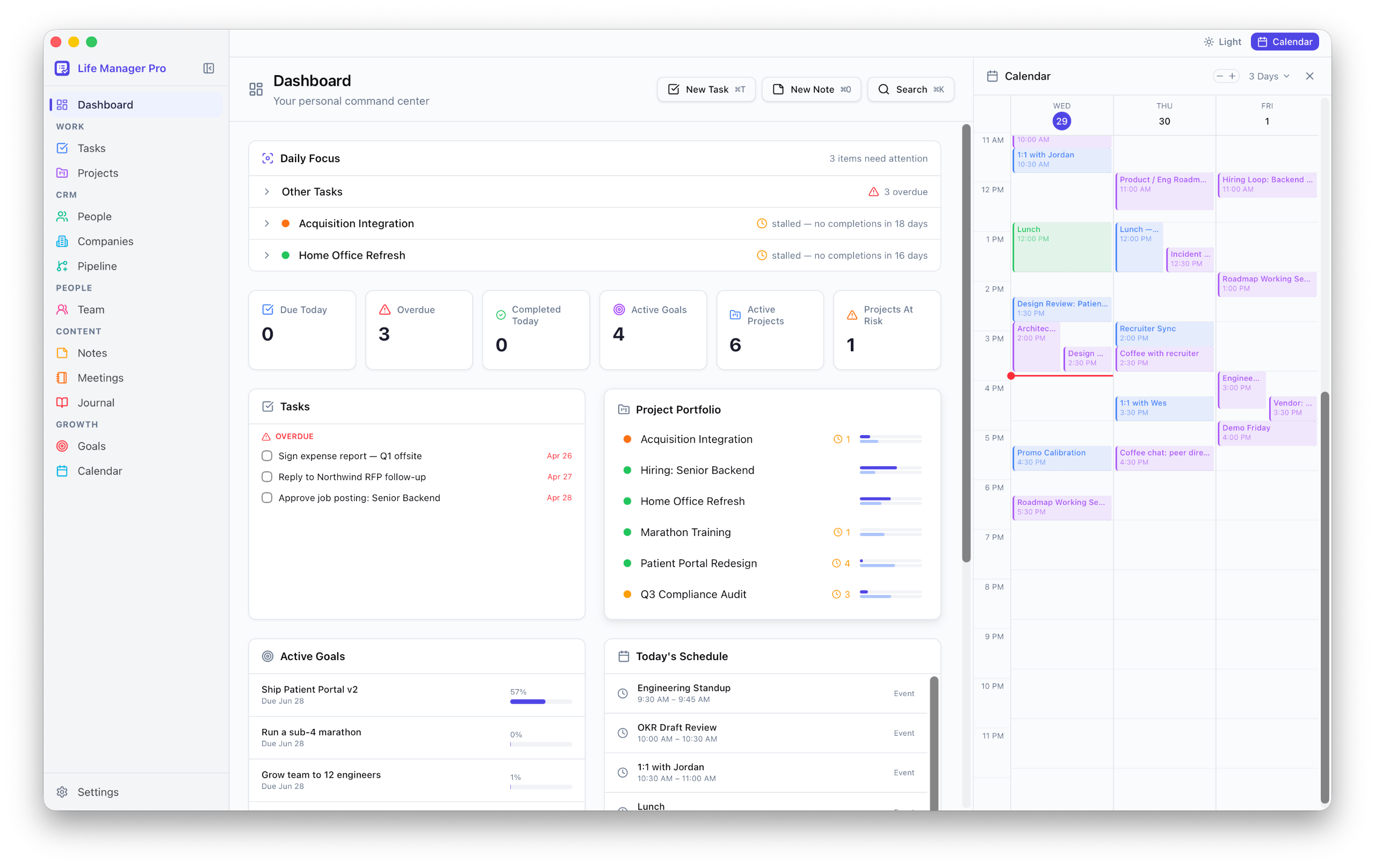
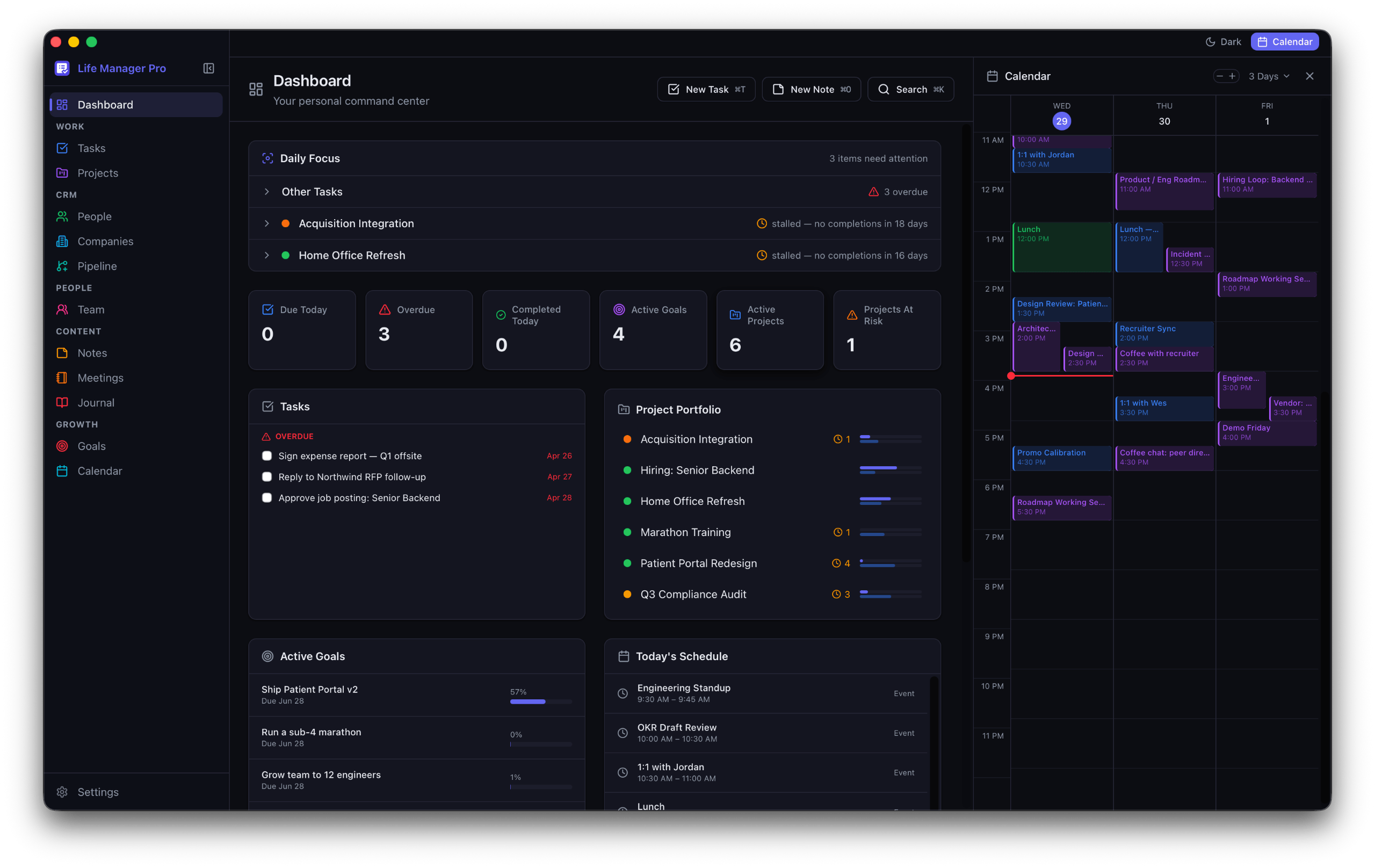
Meeting action items land here, next to the projects and goals they belong to.
The attribution problem gets explicit handling, because getting it wrong is worse than leaving it blank. The analysis is instructed to only assign something to you if you actually volunteered or accepted it in your own words — not because another participant mentioned your name near a verb. An unattributed action item you can triage beats a confident wrong one you’ll trust and then resent.
None of this makes the transcript better. The transcript is the same transcript. It makes the transcript matter, which is a different axis entirely, and the one nobody else is competing on.
Meetings that turn into work, not an archive
Life Manager Pro records and transcribes your meetings locally, then turns the commitments into real tasks alongside your projects, CRM, and goals — one system, not a handoff. $49 once, no subscription. 14-day free trial, no credit card.
Try Life Manager Pro freeIf you’re not switching tools
Most people reading this won’t change apps, and the underlying problem is still worth fixing. Three things that work regardless of what you use:
Do step 4 during the meeting, not after. The last ninety seconds of any call, out loud: “so I’m sending the scope by Thursday, you’re checking with legal.” Type your half into your task manager while you say it. This is more effective than any tool, and it costs nothing.
Give yourself a five-minute processing slot, not an intention. “I’ll review my meeting notes” never happens. A recurring calendar block at 4:30pm to triage the day’s action items into your real task list does, at least sometimes.
Delete the archive you don’t use. If you have two hundred transcripts and reference none of them, they’re not an asset — they’re a third-party retention liability and a reason to feel bad. Keep what you’d genuinely reopen.
The tooling question is real, but the underlying discipline is “a commitment has to end up somewhere you’ll look.” Whether software does that for you or you do it by hand matters much less than whether it happens at all.